| Food hubs are “businesses or organizations that manage the aggregation, distribution, and marketing of source-identified food products,” per the Michigan State University Center for Regional Food Systems (CRFS). These businesses support movement of locally grown food from US farms to local consumers, as well as strengthen local economies and communities.
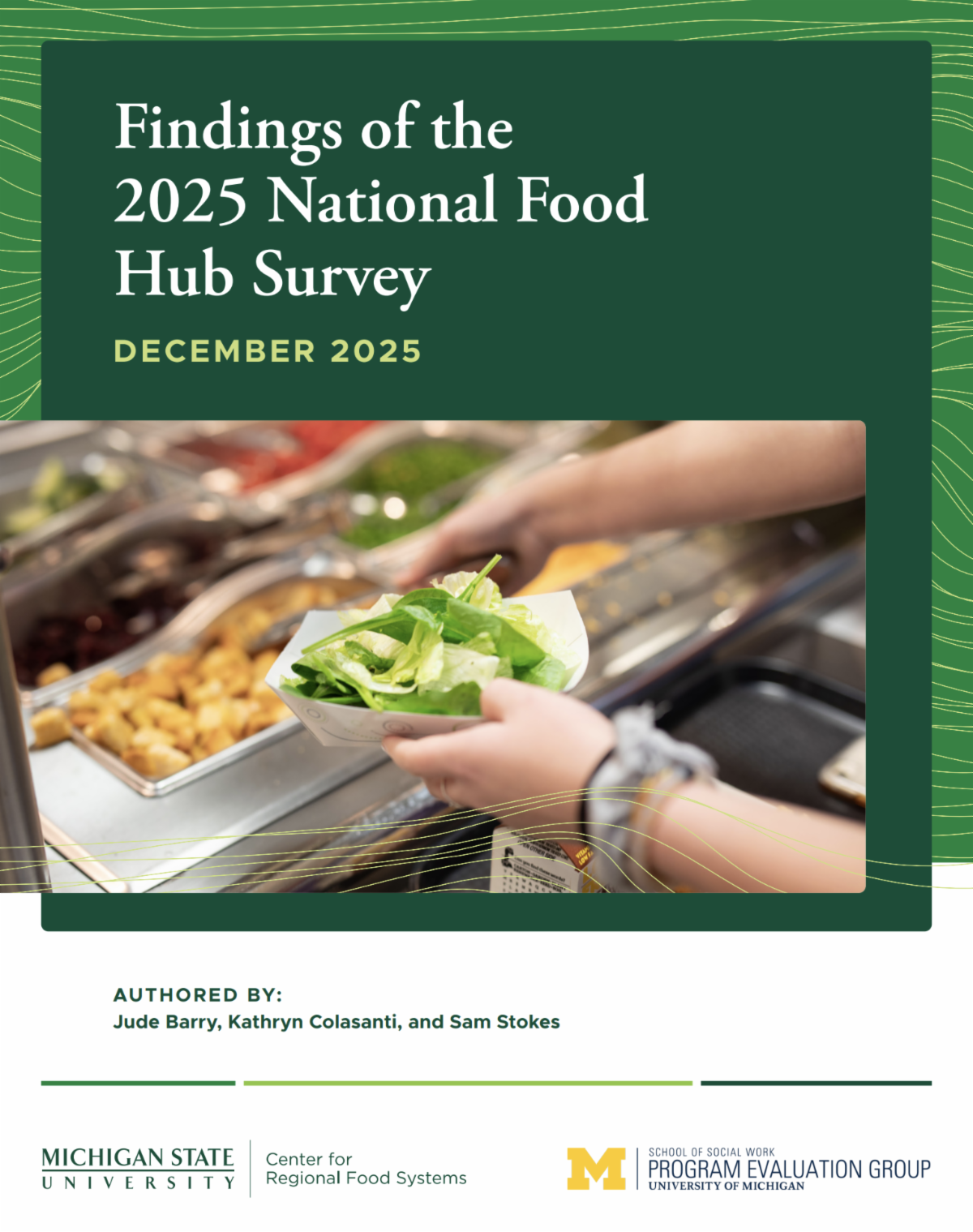
The National Food Hub Survey is a longitudinal research project conducted by CRFS since 2012. The 2025 National Food Hub Survey is the sixth iteration of this survey and was conducted by CRFS in collaboration with the University of Michigan Program Evaluation Group (UM PEG).
The 2025 National Food Hub Survey captured business data from and experiences by food hubs for the 2024 calendar year, notably looking at data following the COVID-19 pandemic. The survey project examines challenges and opportunities for growth in national and regional distribution, especially following times of disruption in the global food supply.
With 100 responses from across the country, including 27 states and the District of Columbia, the survey aims to increase understanding of food hub operational models and their financial viability, the impact food hubs have in their community, and the trends and changes within the food hub sector.
The key findings of the 2025 National Food Hub Survey are outlined in seven sections:
- State of the Food Hub Sector
- Financial Landscape
- Food Hubs as Mission-Driven Organizations
- Food Hub Technical Assistance and Network Needs
- Institutional Sales
- Market Outlook
- Conclusions and Recommendations
The survey results were shared with the National Food Hub Network Community of Practice who provided ideas on how these findings could inform support for these critical members of the food system through a list of recommendations. The conclusions and a list of recommendations can also be found in a separate document. | 











 Posts
Posts
No comments:
Post a Comment
Note: Only a member of this blog may post a comment.